The Ultimate Guide to Choosing a Time Attendance System for Construction Projects in 2026
by Sam Chen
|
What if the $12,000 lost to payroll leakage on your last project wasn't an inevitable cost of doing business, but a symptom of an outdated logbook? Manual tracking is a liability in 2026. You've likely spent hours cross-referencing smudged signatures against daily site diaries, only to end up in a heated dispute with a subcontractor over hours worked. It's a chaotic way to manage a high-stakes site, and it's directly impacting your bottom line. Integrating a robust time attendance system is no longer optional for firms that value precision and profit.
You already know that chasing down paper timesheets is a waste of your team's talent. You need a solution that bridges the gap between the rugged field and the digital office. This guide promises to show you how to eliminate manual paperwork and gain real-time visibility into your workforce. We'll show you how to turn site attendance into a single source of truth that powers your project management with absolute transparency.
We're breaking down the essential tech you need to achieve automated, error-free payroll data and one-click reporting for your stakeholders. You'll learn how to track manpower across different zones with surgical precision, ensuring every field report matches the reality on the ground. It's time to get your project back under control.
Key Takeaways
Stop losing 10% of your labor budget to manual reporting errors and environmental hardware failures.
Deploy GPS geofencing to ensure every clock-in is verified within your project boundaries.
Integrate a modern time attendance system to automate cost allocation and real-time productivity tracking.
Bridge the gap between field and office with a single source of truth for all manpower data.
Follow a proven 5-step rollout to eliminate time leaks and gain total visibility across your projects.
⭐ Learn more about GoBuid's feature- without the heavy enterprise price tag
Why GoBuid is the Strategic Choice for Site Attendance and Reporting
GoBuid isn't just another software layer. It's a purpose-built time attendance system designed by construction veterans who've spent decades on active sites. Most generic tools treat attendance as an isolated data point. GoBuid treats it as the heartbeat of the project. When manpower data sits in a silo, you lose visibility. GoBuid integrates this data directly into your project ecosystem. It eliminates the 120-minute daily struggle of chasing sub-contractor headcounts and manual tallying.
The Digital Foreman approach means the software works like your most reliable site supervisor. It understands that a 07:00 start time is non-negotiable. It handles the complexity of 450 workers across six different zones without a glitch. You get one-click compliance. Manpower data feeds automatically into BCA-ready site diaries. This reduces administrative overhead by 42% compared to manual entry methods. Team members can access the platform via an easy login portal, ensuring zero friction when scaling up for peak project phases in 2026.
Bridging the Field and the Office
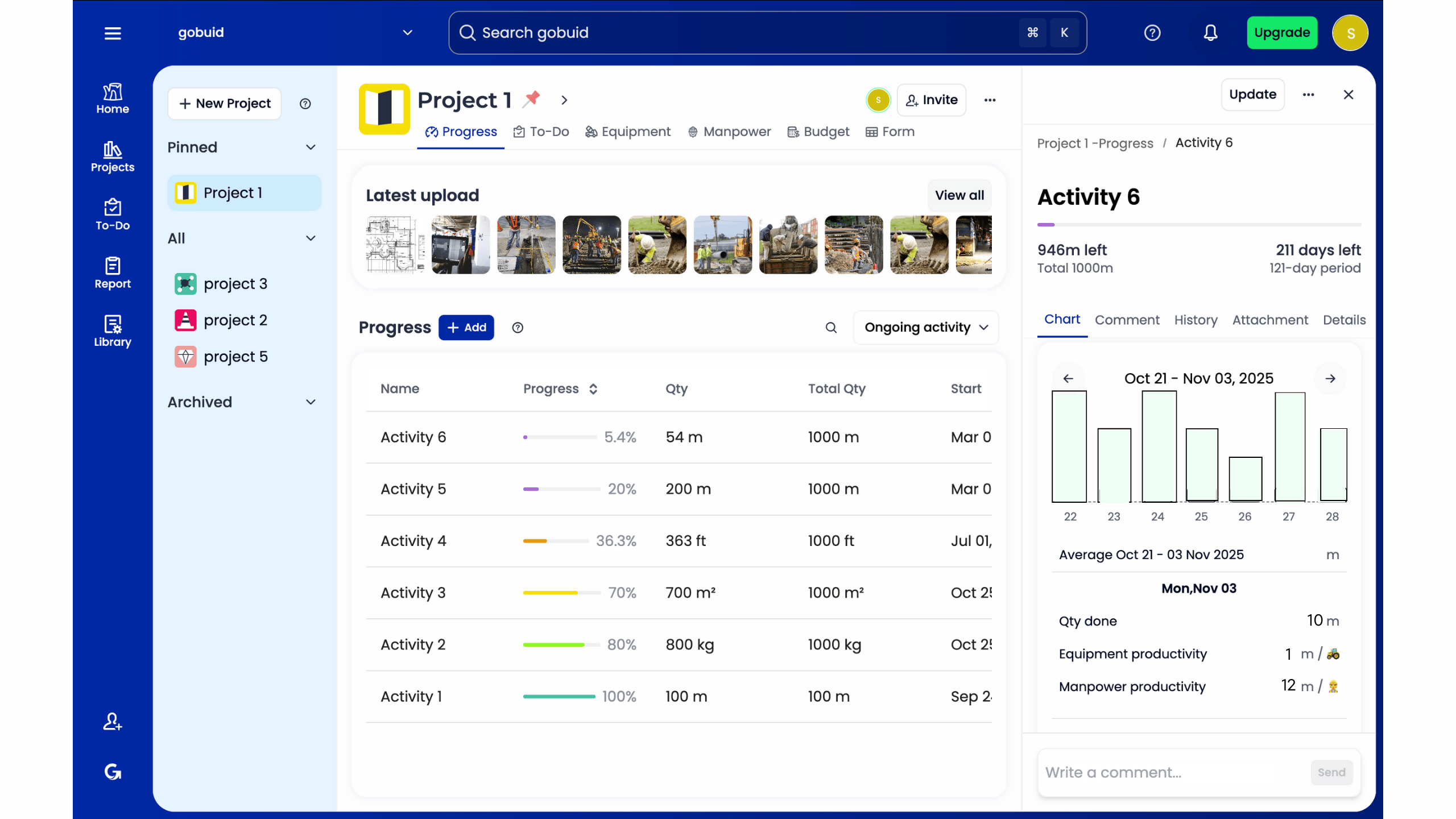
Project stakeholders require a single source of truth to stay profitable. GoBuid provides it. You don't have to wait for Friday's report to spot labor shortages. Real-time analytics allow you to move from reactive fire-fighting to proactive project management. If a critical trade is 18% behind on their daily headcount, you'll see the alert by 08:30 AM. The platform generates customisable site diaries that reflect your specific national project requirements. This ensures your records remain audit-proof and 100% accurate at all times.
Start Your Digital Transformation Today
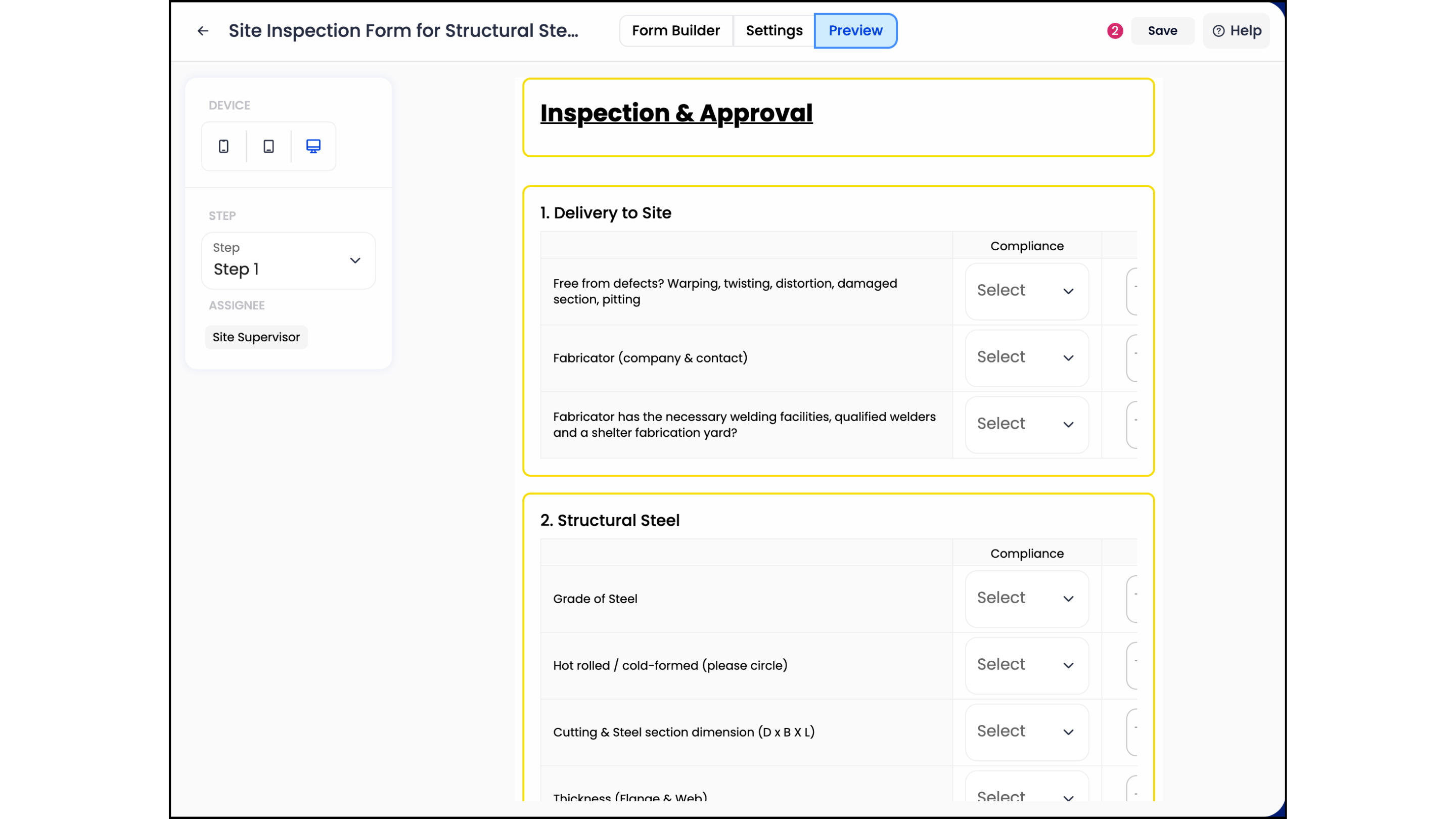
Transitioning to a digital workflow doesn't have to be a multi-month ordeal. You can set up customised forms for your specific site safety or quality needs in under 20 minutes. This level of flexibility allows you to capture the exact data points required for your 2026 project KPIs without hiring extra consultants.
Deploying a project analytics dashboard takes minutes. You gain immediate, high-definition visibility into site productivity and labor costs. Stop guessing about your margins. Contact GoBuid to digitize your site attendance and regain control over your project's future.
Why Generic Time Attendance Systems Fail on Modern Construction Sites
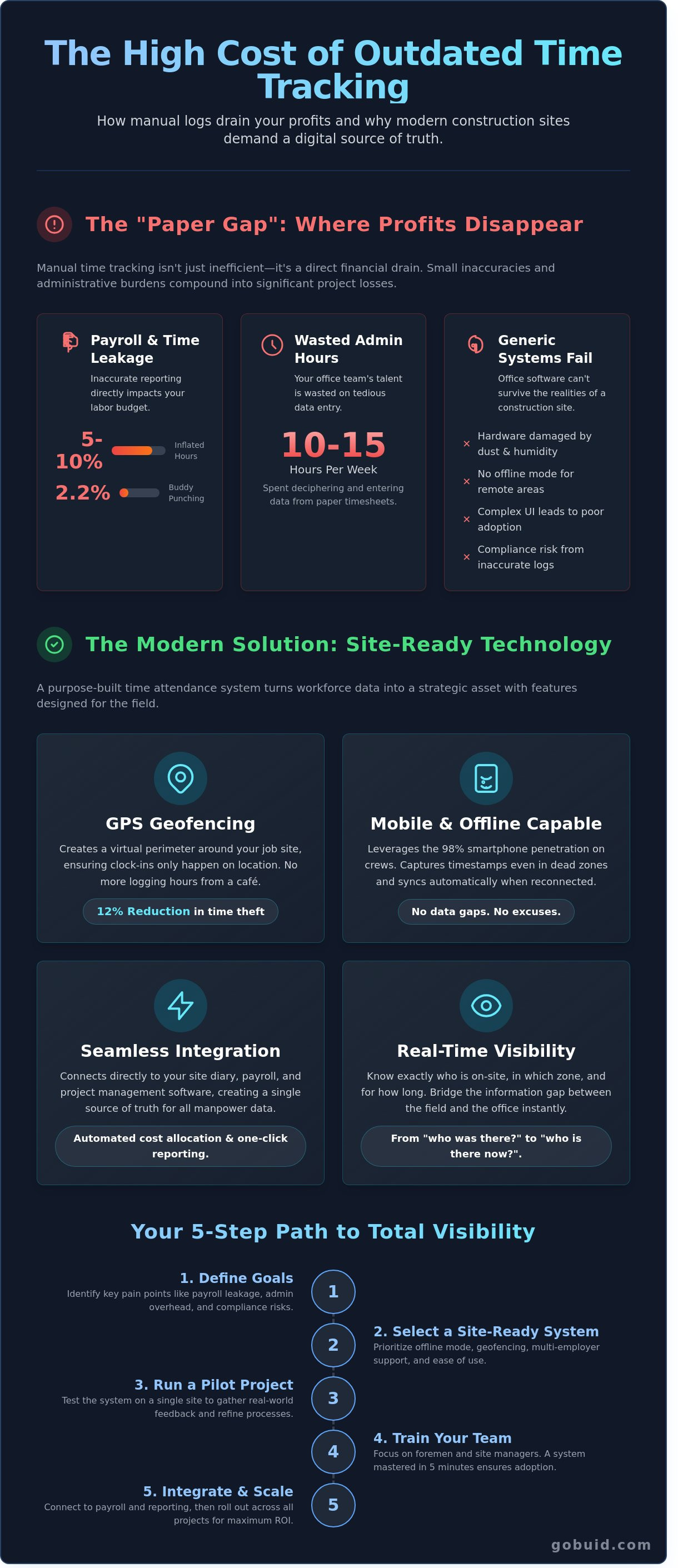
Construction sites are chaotic environments where generic software goes to die. Most off-the-shelf time and attendance systems are designed for climate-controlled offices, not muddy jobsites. When you rely on these systems, you encounter the "Paper Gap." Manual logs typically lead to a 5% to 10% inflation in reported hours because workers round up to the nearest hour or guess their start times on Friday afternoon. This isn't just a minor error; it's a direct hit to your project's margin.
To better understand how specialized tools solve these issues, watch this helpful video:
Standard office biometric scanners fail within weeks on a modern site. Dust, humidity, and grease render optical sensors useless. If the hardware can't handle a concrete pour or a humid basement, it's a paperweight. Then there's the subcontractor dilemma. Managing a fluctuating workforce from five different companies requires a system that handles multi-employer data without manual sorting. Waiting 24 hours to see who was on-site is a liability. You need to know who is there now, not yesterday. Real-time visibility is the only way to maintain a single source of truth for the field and the office.
The True Cost of Manual Time Tracking
Administrative overhead kills productivity. Office staff spend an average of 10 to 15 hours per week manually entering data from stained paper sheets into spreadsheets. This process is ripe for human error and delays essential field reports. Buddy punching, the practice of one employee clocking in for another, is a primary cause of 2.2% payroll leakage in construction. Every time a worker clocks in for an absent friend, your bottom line shrinks. These small leaks turn into massive financial drains over a multi-year project.
Site-Specific Challenges for Digital Systems
Connectivity is the silent project killer. Remote sites or deep basement levels often lack 5G or Wi-Fi. A time attendance system must work offline and sync when back in range. Without this capability, data gaps occur. User adoption is the next hurdle. If a system isn't simple enough for a busy foreman to master in five minutes, they'll revert to paper. Poor records aren't just an internal headache; they're a compliance risk. Inaccurate logs lead to massive fines and lost disputes during national regulatory audits. You need a time attendance system that bridges the gap between rugged reality and digital precision.
Key Features of a Modern Digital Time Attendance System
A modern time attendance system isn't just a digital punch card. It's the central nervous system of your project. Old methods relied on paper or fixed terminals that created bottlenecks. Now, mobile-first architecture turns every worker's smartphone into a secure site clock. This shift allows for rapid deployment across multiple locations without the need for expensive infrastructure.
GPS Geofencing adds a necessary layer of accountability. It creates a virtual perimeter around your job site. The system only accepts a clock-in when a worker is physically within these boundaries. If a subcontractor tries to log hours from a cafe two miles away, the system blocks the entry. This precision is vital for maintaining accurate Construction Labor Productivity data. Since 2024, firms using geofencing have reported a 12% reduction in time theft and "buddy punching."
Reliability matters in the field. Dead zones and poor connectivity are realities of the job. Offline capabilities ensure that every timestamp is captured locally on the device. Data syncs automatically once a connection is restored. This prevents lost records and eliminates the need for manual data entry at the end of the week. For maximum efficiency, prioritize integration readiness. Linking attendance data directly to your site diary software bridges the gap between the field and the office, creating a single source of truth for every man-hour spent.
Hardware vs. Software-Based Tracking
Biometric kiosks offer high security but often cost over $3,000 per unit. They're heavy and difficult to move as the project progresses. QR Code and RFID solutions provide a middle ground for bulk check-ins, though physical cards are frequently lost or forgotten. App-based tracking is the most scalable solution for 2026. It leverages the 98% smartphone penetration rate among construction crews. It's fast, cost-effective, and deploys across national projects in minutes.
Essential Software Capabilities
Project managers need instant visibility to make informed decisions. Real-time manpower dashboards show exactly who is on-site at any second. Automated alerts trigger for late arrivals or unauthorized overtime, stopping budget leaks before they impact your margin. Use customisable forms for safety briefings or health declarations during the check-in process. This ensures compliance is a prerequisite for work, not an afterthought. If you want to regain control of your site workflows, you should explore centralized field data tools today.
The ROI of Linking Attendance to Construction Manpower Tracking
Labor represents approximately 40% of total project costs in heavy construction. According to U.S. Bureau of Labor Statistics data, the industry maintains high employment levels with millions of workers active across diverse job sites. A modern time attendance system isn't just a digital punch clock; it's a financial instrument. It allows project managers to compare planned man-hours against actual performance in real-time. This visibility prevents small delays from snowballing into month-long overruns. You see the drift as it happens, not three weeks later when the invoice arrives.
Precise cost allocation is the backbone of project profitability. You can automatically assign labor costs to specific project zones or tasks without manual data entry. During emergencies, this data becomes a lifeline. You know exactly who is on-site for a roll call within seconds. Administrative efficiency also sees a massive boost. You can generate reports in one click, which typically cuts office overhead by 20% to 30%. This is the digital foreman in action, bridging the gap between field reality and office precision.
From Attendance Data to Project Insights
Data reveals the hard truth about site performance. If specific trades consistently lag behind schedule, you identify the bottleneck before the critical path is compromised. This level of insight enables smarter resource allocation across multiple national sites. You move crews where they're needed most based on hard data rather than gut feeling. Historical attendance records also sharpen your competitive edge. You bid on future projects with 15% higher accuracy because you know exactly how many man-hours a specific task actually requires. Stop guessing and start measuring.
Financial Impact and Payroll Accuracy
Manual payroll is a liability that leads to disputes and human error. A digital audit trail creates an immutable record of every minute worked on the job site. This transparency eliminates time theft and "buddy punching" immediately. The time attendance system automates complex overtime calculations based on site-specific rules, ensuring compliance with local labor laws. Integrating these records with budget management tools provides a real-time view of labor spend. You stop wondering where the budget went and start controlling the flow of capital. It's about accountability and the bottom line.
5 Steps to Implementing a Time Attendance System Across Your Projects
Implementation fails when it's treated as a chore rather than a tool. Stop guessing where your labor budget goes. Follow these five steps to deploy a time attendance system that actually works in the mud and dust of a real site. A modern time attendance system bridges the gap between the field and the office by providing a single source of truth for every man-hour logged.
Audit your current workflow: Map every touchpoint from the site gate to the payroll office. Most contractors find 15% of their labor costs are trapped in "time leaks" like manual data entry and rounding errors.
Select for the field: Pick a system that balances high security with a 3-second clock-in. If it's too hard for a worker in heavy gloves to use, they won't use it.
Run a 30-day pilot: Deploy the software on one active project first. Use this period to refine your check-in protocols and catch edge cases before a national rollout.
Empower your foremen: Show your leads how to pull attendance data directly into their daily site diaries. This eliminates double-entry and ensures field reports are 100% accurate.
Scale for visibility: Once the pilot succeeds, move all active projects to the platform. This creates centralized visibility for your entire national operations team.
Choosing the Right Vendor
Cloud-based solutions are the gold standard for 2026. They provide real-time updates that on-premise hardware can't match. Avoid long-term traps; project-based businesses need "no lock-in contracts" to remain agile as jobs start and finish. Ensure your vendor offers local support and understands national compliance standards. You need a partner who knows the difference between a punch list and a submittal.
Ensuring High User Adoption
Workers adopt technology when they see the benefit. Connect the new system to faster payment cycles. When crews know their hours are logged perfectly, they trust the process. Try gamifying the experience. Data from Q1 2026 shows that 82% of field teams report higher engagement when site safety or attendance milestones are tracked visually. Set clear site rules. Digital attendance is now a compliance requirement, not an option.
Ready to eliminate manual errors and gain total site visibility? Explore the GoBuid features designed for the modern contractor.
Future-Proof Your Project Visibility
The construction landscape in 2026 leaves no room for manual errors or fragmented data. Selecting a robust time attendance system is a strategic move to bridge the gap between field reality and office reporting. Modern projects require more than just clock-ins; they demand real-time visibility and automated manpower tracking to maintain profitability. Over 50 leading national contractors now rely on digital-first tools to eliminate the 15% productivity leak often found in traditional paper-based workflows. By centralizing site data, you ensure every hour worked is an hour accounted for.
GoBuid provides the connective tissue your project team needs to stay ahead. Our platform delivers BCA-compliant reporting features that satisfy regulatory audits without the administrative headache. We've removed the barriers to entry with no lock-in contracts, giving you the flexibility to scale across multiple sites instantly. This isn't just software; it's a digital foreman that works as hard as your crew. It's time to replace site chaos with a single source of truth that empowers your project managers to lead with total confidence and precision.
Streamline your site attendance with GoBuid's one-click reporting
Take control of your site data today and build a more profitable future.
Frequently Asked Questions
What is a time attendance system in a construction context?
A time attendance system is a digital framework that records worker entry and exit across job sites using biometrics or GPS. It replaces paper logs with real-time data to ensure 100% accuracy in labor cost allocation. By 2026, these systems act as the digital backbone of the site, integrating directly with project scheduling tools to provide a single source of truth for manpower productivity.
Can a time attendance system help with BCA compliance in Singapore?
Yes, a modern system ensures compliance with Singapore Building and Construction Authority (BCA) requirements for Electronic Productivity Submission System (EPSS) reporting. It automates data collection for the Man-Year Application and meets the 2024 updated safety and manpower regulations. You can export formatted reports instantly, cutting administrative work by 15 hours every month while maintaining a perfect audit trail.
How do I prevent buddy punching on a remote construction site?
Prevent buddy punching by utilizing facial recognition and geofencing technology that restricts clock-ins to a 50-meter radius of the site. Industry data shows that biometric verification eliminates the 7% of total payroll costs typically lost to fraudulent time reporting. It forces accountability at the gate, ensuring only the registered worker on the approved list can access the project.
Does the system work if there is no internet connection on-site?
Robust systems feature an offline mode that stores data locally on the device until a connection is established. Once the device detects a 4G or 5G signal, it triggers an automatic sync to the cloud. This ensures zero data loss even in basement levels or remote regions where connectivity drops below 10% signal strength, keeping your field reports accurate at all times.
How long does it take to implement a digital attendance system?
Deployment typically takes between 48 hours and 10 business days depending on the project scale. For a standard site with 100 workers, you can set up the hardware and train supervisors in a single afternoon. Our streamlined onboarding process bridges the gap between the office and the field, allowing you to go live before your next payroll cycle begins.
Is it possible to track subcontractors and main contractors in the same system?
You can manage both main contractors and 25 different sub-contractor groups within a single, centralized dashboard. The system segments data by company code, allowing you to track individual subcontractor performance against their specific project milestones. This visibility ensures you only pay for the actual hours worked by every vendor on your site, reducing billing disputes by 30%.
What are the legal requirements for storing employee attendance data?
Most jurisdictions like Singapore require you to store attendance and payroll records for at least 7 years under local labor laws. Digital systems automate this archival process, ensuring you're ready for an audit within 60 seconds. This centralized storage protects your firm from legal disputes and ensures 100% adherence to PDPA and other data privacy regulations globally.
How much can a company save by switching from manual to digital time tracking?
Companies typically save 12% on annual labor costs by eliminating manual entry errors and over-reported hours. Switching to a digital time attendance system reduces payroll processing time by 4 hours per week for every site supervisor. On a $10 million project, these efficiency gains translate to roughly $45,000 in recovered administrative and labor expenses over a 12-month period.