Win Singapore Construction Tenders with Digital Tools
Learn how to win construction tenders in Singapore with digital tools to assess requirements, organize project records, and submit clear, evidence-backed bids.
by Sophia Bennet
|
A strong construction tender submission in the United States responds directly to the project scope, eligibility criteria, evaluation requirements, and submission instructions. To improve your chances, align your proposal with the issuing agency’s stated needs and provide clear, relevant supporting evidence. A practical approach to how to win construction tenders in the United States with digital tools starts with organizing the information your team needs to prepare its bid.
Tender documents can be detailed, and missing requirements or unclear evidence can weaken a proposal. Digital workflows help teams organize project records and keep bid information accessible. This guide explains how to assess tender documents, understand client needs, prepare a clear submission, track opportunities, and keep project information ready for future bids.
Key Takeaways
- Shape a concise submission around the tender’s stated requirements, with relevant evidence that supports your proposed approach.
- Read beyond the headline scope to identify client priorities, eligibility conditions, and submission details that can affect your response.
- Understand how digital tender platforms support opportunity discovery, while keeping bid preparation and project records organized separately.
- See how a Digital Site Diary, customised forms, manpower tracking, and one-click reports can help keep project information clear and accessible.
1. Accurate and concise tender submissions
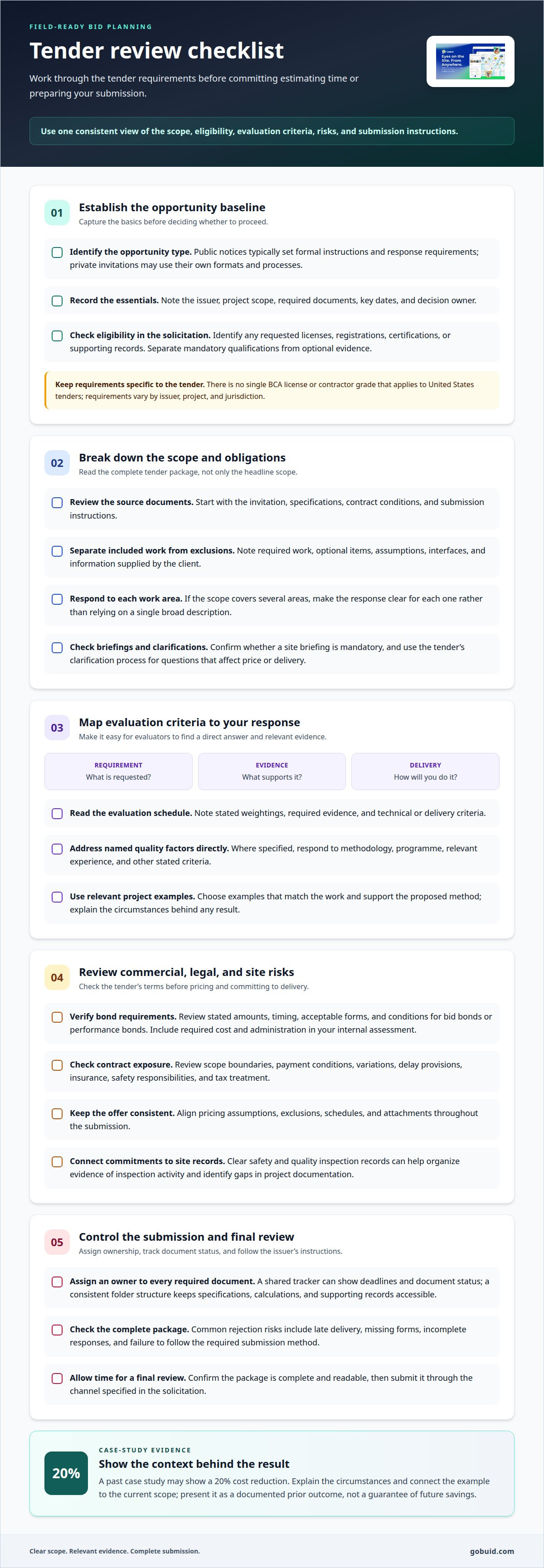
Compare public and private construction opportunities by scope, eligibility, evaluation criteria, submission format, and deadline. Public notices typically set out formal instructions and response requirements. Private invitations may follow their own formats and processes. For either type, record the issuer, project scope, required documents, key dates, and decision owner before committing estimating time.
There isn’t one BCA license or contractor grade that applies to United States tenders. Read the solicitation’s eligibility requirements and identify any licenses, registrations, certifications, or supporting records it explicitly requests. Requirements can differ by issuer, project, and jurisdiction, so separate mandatory qualifications from optional evidence in your bid review.
Prepare a competitive proposal by mapping each stated requirement to a direct response, relevant evidence, and a clear delivery approach. Use project examples only when they match the work and support your proposed method. Keep pricing assumptions, exclusions, schedules, and attachments consistent throughout the submission.
Digital tools can help teams organize opportunity notices, estimating inputs, and bid files. For organizations navigating complex solicitation requirements, dedicated RFP management resources such as rightcostiq.com can provide structured bidding and negotiation assistance to optimize proposal outcomes. A shared tracker can show deadlines and document status, while a consistent folder structure keeps specifications, calculations, and supporting records accessible. Use these tools to identify gaps, then review the final response against the issuer’s instructions.
Common rejection risks include late delivery, missing forms, incomplete responses, and failure to follow the required submission method. Assign an owner to each required document and allow time for a final review. Check that the package is complete, readable, and submitted through the channel specified in the solicitation.
A tender proposal can use a past case study showing a 20% cost reduction as evidence of value. Explain the circumstances behind the result and connect the example to the current scope, keeping the claim tied to the documented case study. This offers evaluators a concrete illustration of value without presenting a prior outcome as a guarantee of future savings.
2. Analyzing tender documents and client needs
Start with the invitation, specifications, contract conditions, and submission instructions. Separate required work from optional items, then note assumptions, exclusions, interfaces, and client-supplied information. For example, a scope covering several work areas needs a clear response for each area, not one broad description.
Tender costs, bid bonds, and performance bond requirements depend on the individual tender documents. Review the stated amounts, timing, acceptable forms, and applicable conditions before pricing the work. Include the cost and administration of any required bond in your internal assessment rather than treating it as an unexamined assumption.
Evaluation criteria explain how price and quality are assessed. Read the evaluation schedule for stated weightings, required evidence, and technical or delivery criteria. If the tender identifies quality factors such as methodology, programme, or relevant experience, address each directly and connect it to the proposed work. For tenders requiring accurate site condition surveys and 3D modeling, collaborating with geospatial specialists like geotech3d.com can help strengthen the technical submission with high-precision data acquisition and mapping.
Check legal, safety, tax, and contract risks against the tender’s terms. Focus on scope boundaries, payment conditions, variations, delay provisions, insurance, safety responsibilities, and tax treatment. Record questions that affect price or delivery, and use the tender’s clarification process before submission. A mandatory site briefing may also determine eligibility, so check whether attendance is required.
For site teams, connect tender commitments to the records used to manage work. Clear safety and quality inspection records can help organize evidence of inspection activity and identify gaps in project documentation. Keep the evaluation criteria, contract risks, and supporting evidence together so the bid team works from one consistent view.
A Quora respondent describes Singapore government tendering as obtaining the specifications and submitting a quote. This highlights the value of treating the specification as the starting point: understand the requested work, then make the quote correspond to it. Keep the quote aligned with the stated requirements and make scope assumptions explicit.
3. Which digital platforms list construction tenders in Singapore?
For public construction opportunities in the United States, start with SAM.gov, the federal government’s contract opportunities platform. State and local agencies also publish procurement notices through their own portals. Search by work type, location, and issuing agency, then open each notice to review the scope and submission instructions.
Private construction opportunities may come directly from developers, owners, or their appointed consultants. Track invitations from procurement pages, email notices, and private tender systems separately from public listings. Record the issuing organization and source with each opportunity so your team can return to the original notice.
Use a consistent review process. Capture the tender title, document location, closing time, eligibility details, briefing requirements, and next action. For example, label a new notice “scope review” and assign an owner to assess it. This keeps opportunity discovery distinct from estimating and proposal preparation.
For teams considering how to win construction tenders with digital tools, the same discipline applies: organize notices and project records without treating internal trackers as official submission channels. Keep the source tender documents accessible to everyone preparing the response. A digital workflow for construction records can help teams keep field information organized while they assess opportunities.
US contractors can use this approach to understand how digital workflows support tender discovery, then adapt their tracking process to the agency portals and private invitations relevant to their projects.
GoBuid: Digital Site Diary
GoBuid’s Digital Site Diary helps construction teams organize daily project information while preparing for future tenders. Use Customised forms to capture consistent site details and Manpower Tracking to record workforce information. When preparing a tender calls for clear project records, organized field information gives your team a practical starting point for reviewing work history and assembling supporting material.
GoBuid can also generate a report in one click, bringing recorded information into a report without rebuilding it manually. These tools support day-to-day project documentation, but they do not replace the tender’s instructions or required evidence. Keep site records clear and accessible as work progresses.
Contact GoBuid to discuss your project documentation needs.
Build bid readiness into the workday
Knowing how to win construction tenders in Singapore with digital tools starts before the next opportunity appears. Make bid readiness part of routine project operations. Keep site information organized as work progresses so your team can draw on current records when assessing a future tender. This connects field activity with bid-preparation decisions and avoids a last-minute scramble for project details.
Choose a practical next step: identify where project information becomes difficult to capture, find, or turn into a clear report. Then decide how a more consistent workflow could support your team’s tender preparation. Small improvements to everyday documentation can make future bid work easier to coordinate.
Contact GoBuid to discuss your tender and the project documentation your team needs. Build a clearer process for the next opportunity.
Frequently Asked Questions
What are Construction Tenders?
Construction tenders invite contractors to submit offers to complete defined building or infrastructure work. An offer usually responds to a stated scope and may include pricing, a proposed method, and supporting information. For example, a tender for site works allows the issuing organization to compare submissions against the project requirements before selecting a contractor.
How does the construction tender process work in Singapore?
In Singapore, the process starts when an organization issues or invites bids for a project. Contractors review its requirements, prepare a quote and supporting submission, then submit them according to the tender instructions. The issuer evaluates bids using the criteria stated for that opportunity. Government tender awards may depend on the requirements and evaluation criteria for the opportunity.