How to Standardize Construction Reporting for Predictable Project Outcomes
Get predictable project outcomes. This guide shows you how to standardize construction reporting, unify field data, and turn admin chaos into one-click insig...
by Sheldon Huang
|
With labor shortages causing an average of two months of project delays in 2026, every hour lost to manual data entry is an hour your project can't afford. You've likely spent your Sunday nights trying to reconcile inconsistent reports from different subcontractors. It's a frustrating process that hides the real status of your manpower. Learning how to standardize construction reporting is the only way to reclaim those hours and gain real-time visibility into your site activities. When field data is scattered across paper logs, you lose the control needed to keep a project on track.
We understand that you need a system that works as hard as your crew does. This article provides the exact framework you need to unify field data and generate professional insights with a single click. We'll walk through the steps to move from administrative chaos to a single source of truth for all site activities. By the end of this guide, you'll know how to eliminate reporting errors and reduce overhead, ensuring your team stays focused on high-quality execution rather than paperwork.
Key Takeaways
- Understand why uniform data capture is the essential foundation for accurate project analytics and cross-project benchmarking.
- Master how to standardize construction reporting through a practical 5-step framework that starts with auditing your stakeholder requirements.
- Simplify field data entry using customized forms to ensure subcontractors provide consistent information without the friction of manual paperwork.
- Transition from hours of administrative compilation to generating professional reports in one click to improve transparency and stakeholder trust.
The Pillars of Standardized Construction Reporting
Standardized construction reporting is a uniform process for capturing, categorizing, and distributing project data. It isn't just about filling out a daily log; it's about creating a consistent language across your entire operation. This structure is essential for effective Construction management, as it allows project leaders to compare performance across different sites without translating various reporting styles. Standardization is the only way to achieve accurate project analytics and reliable cross-project benchmarking. Without it, you're making decisions based on fragmented guesses rather than hard facts.
To better understand how standardization transforms project delivery, watch this helpful video:
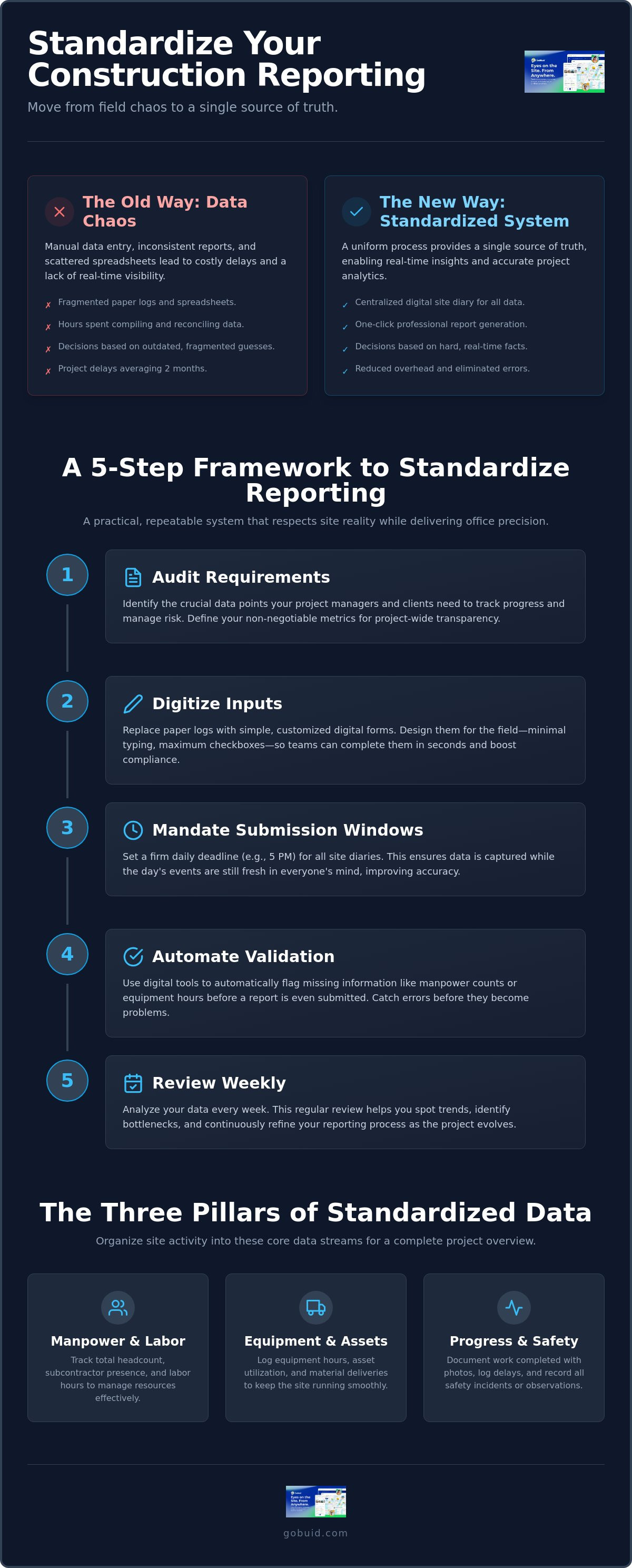
Effective reporting organizes site activity into three core data streams: Manpower and Labor, Equipment and Assets, and Site Progress and Safety. Most teams operate in a reactive state, where managers spend hours chasing data from subcontractors. Standardized reporting changes the flow so that data moves automatically from the field to the office. This shift ensures that site activities are documented as they happen, providing the real-time visibility needed to prevent minor issues from becoming major delays. This is the first step in how to standardize construction reporting for long-term success.
Moving Beyond Fragmented Spreadsheets
Excel chaos carries hidden costs that drain your project's profitability. Data silos and version control issues make it nearly impossible to find a single, accurate version of yesterday's events. A centralized Digital Site Diary acts as the single source of truth for the entire team. It replaces scattered spreadsheets with a unified platform where every entry is timestamped and verified. This centralization ensures that your project history is always accessible and ready for audit.
Defining Universal Data Points for Your Site
Consistency requires specific metrics that every report must include. Your team needs to capture weather conditions, total headcount, equipment hours, and specific delay causes every day. A Unified Data Point is the non-negotiable metric that allows for project-wide transparency. By defining these metrics early, you ensure that every stakeholder sees the same reality. This clarity reduces friction and allows your team to focus on moving the project forward instead of debating the accuracy of the data.
A 5-Step Framework to Standardize Your Reporting
Standardization isn't a one-time event; it's a repeatable system. To master how to standardize construction reporting, you need a framework that respects site reality while delivering office precision. Start by auditing your current reporting requirements. Look at what your stakeholders actually need to see. For example, the Facilities Standards (P100) set by the U.S. General Services Administration show how rigorous criteria ensure consistency across massive portfolios. Use these benchmarks to define your own mandatory data points.
Follow these five steps to build your system:
- Step 1: Audit requirements. Identify the specific data points your project managers and clients need to track progress and manage risk.
- Step 2: Digitize inputs. Replace paper logs with Customized Forms that field teams can complete in seconds.
- Step 3: Mandate submission windows. Set a firm deadline, like 5 PM daily, to ensure site diaries are finalized while the day's events are fresh.
- Step 4: Automate validation. Use digital tools to flag missing manpower counts or equipment hours before the report is submitted.
- Step 5: Review weekly. Analyze your data every Friday to refine how to standardize construction reporting as your project evolves.
Designing Custom Forms for Field Consistency
Build forms that field teams will actually use. This means minimal typing and maximum checkboxes. When a foreman can tap through a list in minutes, compliance naturally increases. Always include Progress Photos & Documentation to provide visual context. Photos eliminate ambiguity and provide an indisputable record of work completed. If you want to move faster, using a digital site diary is the most efficient way to bridge the gap between the field and the office.
Establishing Real-Time Documentation Workflows
Create a digital flow where data is captured the moment activity occurs. Waiting until the end of the shift leads to guesswork and inaccurate manpower logs. Mobile-first tools empower foremen to record progress on the move. This ensures compliance from the ground up and turns documentation into a productive habit. When data flows in real-time, you gain the visibility needed to keep projects on schedule and budgets under control.
Scaling Efficiency with One-Click Digital Tools
Standardization is the engine that drives project efficiency. Once you've established a uniform data collection process, you can finally stop manually compiling spreadsheets. Knowing how to standardize construction reporting allows your team to transition to one-click reporting. This shift doesn't just save time; it builds massive stakeholder trust. When clients and partners receive professional, consistent documents every day, your brand image reflects a level of control and precision that manual reporting can't match.
A unified data set feeds directly into a Project Analytics Dashboard. This provides high-level oversight that was previously impossible with fragmented logs. For teams operating on a global scale, following frameworks like the International Cost Management Standard (ICMS) ensures that your standardized cost and progress data remains compliant with international best practices. The ultimate goal of this entire system is simple: buy back time for your project team so they can focus on building, not bookkeeping.
Automating Analytics for Project Oversight
Standardized data allows for the instant tracking of Key Performance Indicators (KPIs). You can monitor labor productivity and equipment utilization across multiple sites from a single screen. When reporting is uniform, Equipment Management becomes a passive task. The system automatically tracks hours and locations based on the field inputs, alerting you to inefficiencies before they impact the bottom line. This level of automation turns raw site activity into actionable intelligence.
Eliminating Administrative Lag in Project Management
The time savings from standardization are immediate and measurable. Many project managers reduce their daily reporting time from two hours of manual entry to just two minutes of review. This elimination of administrative lag ensures that decision-makers always have the most current information. If you're looking to upgrade your tech stack, reviewing the Best Construction Project Management Software 2025 can help you select a platform that supports these automated workflows. Stop chasing data and start using it to drive predictable project outcomes.
Take Command of Your Site Activity
Standardizing your reporting isn't an administrative burden. It's a strategic move to eliminate the chaos of manual logs and fragmented data. By implementing a clear framework and defining your core data streams, you ensure every stakeholder has the same visibility into site activities. You've seen how to standardize construction reporting by moving from reactive chasing to an automated, digital flow. This change buys back hours for your team and provides the professional insights needed to stay on schedule and within budget.
It's time to stop fighting with spreadsheets and start driving results. With real-time manpower and equipment tracking, you can maintain total transparency without the administrative overhead. GoBuid offers total flexibility with no lock-in contracts, giving you the tools to improve your execution immediately. Streamline your site today with GoBuid's one-click reporting and generate professional reports in one click. Build with confidence and keep your focus where it belongs; on the field.
Frequently Asked Questions
What is the most important report in construction?
The Daily Site Diary is the most critical document because it serves as the primary record of all site activity. It captures essential data points like manpower counts, equipment hours, and weather conditions that directly impact the project schedule. This report provides the evidentiary foundation needed for progress claims and dispute resolution; making it the most vital tool for maintaining operational transparency and accountability across the entire project team.
How do I get subcontractors to follow a standardized reporting format?
Compliance starts with reducing friction and setting clear contractual expectations. Provide subcontractors with mobile-friendly digital forms that use checkboxes and photo uploads instead of requiring lengthy written descriptions. When you demonstrate how to standardize construction reporting using a process that takes less than two minutes, teams are more likely to participate. Consistent reporting should be treated as a non-negotiable project requirement to ensure data integrity.
Can I standardize reporting without using specialized software?
You can establish a standard using paper templates or shared spreadsheets; however; these manual methods often lead to data silos and version control issues. While a manual process defines the "what," specialized software provides the "how" by automating the compilation of field data. Digital tools eliminate the hours spent re-keying information, allowing your team to focus on construction rather than administrative data entry; ensuring a higher level of accuracy and speed.
How often should construction reports be submitted to stakeholders?
Internal site diaries must be finalized daily to ensure that manpower and equipment data are recorded while the information is fresh. External stakeholders generally require weekly progress summaries or monthly performance reports. Understanding how to standardize construction reporting allows you to aggregate these daily site entries into high-level reports instantly; ensuring that clients and project owners receive accurate updates without the traditional administrative lag or end-of-month reporting stress.