The Ultimate Guide to Being a Construction Project Manager in 2026
by Sam Chen
|
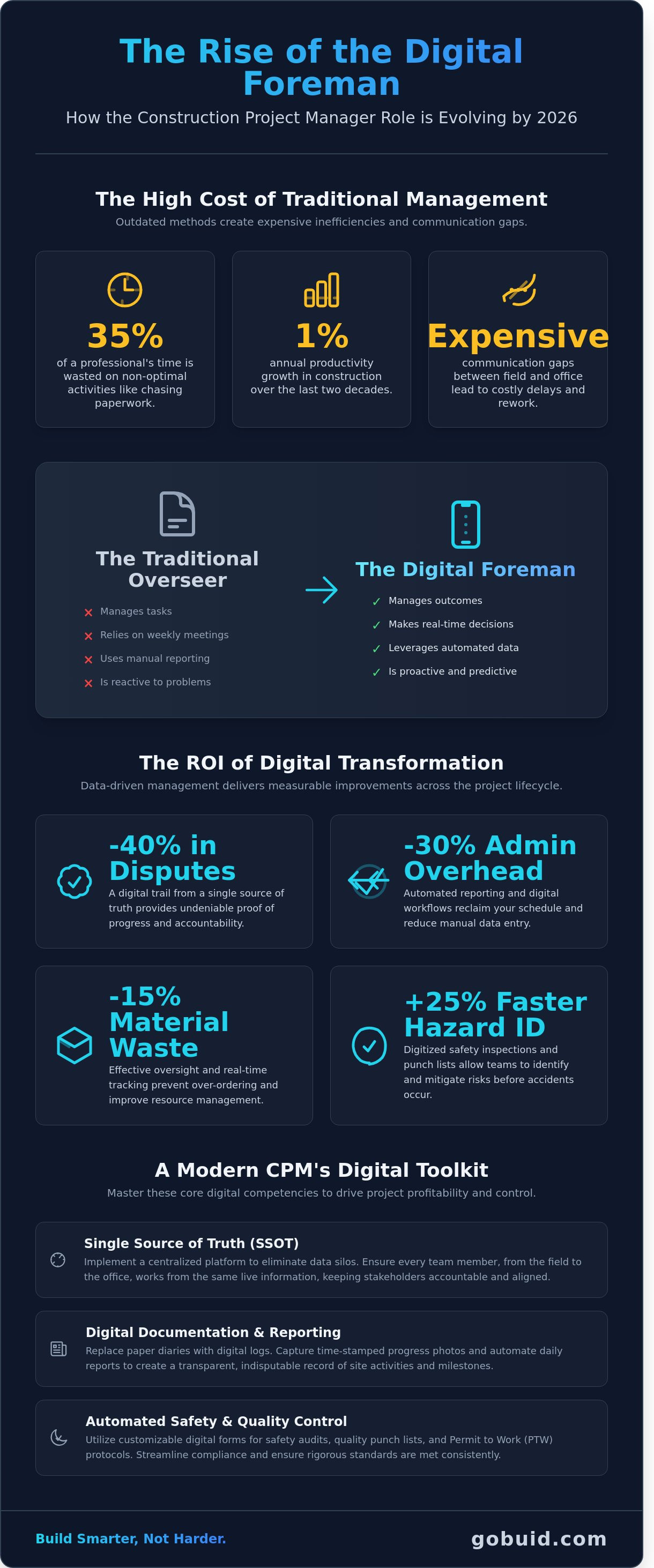
By 2026, the traditional clipboard-carrying construction project manager is extinct, replaced bya data-driven leader who manages outcomes instead of just tasks. You already know that managing a job site feels like fighting a war on two fronts. One side is the physical build, while the other is an endless mountain of administrative paperwork. Communication gaps between the field and the office aren't just annoying; they're expensive. It's a reality where 35% of a professional's time is often wasted on non-optimal activities like hunting down submittals or fixing manual reporting errors.
You deserve a better way to work. This guide provides a clear roadmap to reclaim your schedule and reduce administrative overhead by 30% through superior project visibility. We'll show you how to master the core responsibilities and digital tools required to bridge the gap between rugged site reality and modern software precision. You'll learn the specific skills needed for real-time manpower tracking and how to implement a single source of truth that keeps every stakeholder accountable. From field reports to punch lists, we're building the framework for your most profitable year yet.
Key Takeaways
Transition from traditional oversight to the role of a "Digital Foreman" by bridging the gap between site data and office design.
Master the essential technical skills and qualifications required to excel as a modern construction project manager in an increasingly digital industry.
Eliminate administrative overhead and prevent site bottlenecks using automated reporting and real-time manpower tracking.
Build a high-performance toolkit by selecting purpose-built software that provides a single source of truth for the entire project team.
Overcome common digital adoption hurdles to regain control over workflows and drive project profitability.
⭐ Learn more about GoBuid's feature- without the heavy enterprise price tag
Defining the Construction Project Manager Role in the Digital Era
The role of a construction project manager has shifted. It is no longer just about wearing a hard hat and checking progress on a clipboard. By 2026, the CPM acts as the vital link between the design office and the physical job site. You translate complex blueprints into reality while managing the friction between architectural theory and field practice. You aren't just an overseer. You are a digital foreman who relies on real-time data to drive results and maintain momentum. Efficiency depends on a single source of truth. Without centralized data, projects suffer from communication silos and costly delays. A 2023 industry report found that construction productivity has only grown by 1% annually over the last two decades. Tech-literate managers are the ones changing this statistic. You must be agile. You need to make decisions in minutes based on live field reports rather than waiting for weekly meetings. To better understand this concept, watch this helpful video:
The CPM vs. Site Supervisor: Understanding the Distinction
Site supervisors handle the tactical execution. They manage crews, coordinate daily deliveries, and ensure immediate safety on the ground. As a construction project manager, you handle the strategic "why" and the financial "how much." You own the project's lifecycle. Your focus remains on long-term scheduling, multi-million dollar budgets, and complex contractual obligations. You manage the high-level collaboration between stakeholders, subcontractors, and clients. While the supervisor manages the tools, you manage the project's trajectory.
Why Construction Project Managers are Essential for ROI
Profitability lives or dies by your management. Effective oversight can reduce material waste by up to 15% and prevents the labor overruns that sink profit margins. You mitigate risk through proactive site documentation. If a process isn't recorded, it didn't happen. You also ensure strict compliance with national building authorities and safety standards. This prevents legal bottlenecks and fines that can cost a firm 5% of its total contract value. In 2026, manual tracking is a liability. Adopting the best construction project management software is the only way to maintain the visibility required for modern Construction Management success. You need to be fast. You need to be accurate. Most importantly, you need to be in control.
Key Responsibilities: Managing Site Operations and Compliance
A construction project manager acts as the central nervous system of any job site. They drive the project lifecycle from the first day of pre-construction to the final handover. This role demands more than just technical knowledge; it requires the ability to bridge the gap between complex blueprints and the rugged reality of the field. According to the Bureau of Labor Statistics Occupational Outlook, successful managers must coordinate every phase of construction while managing diverse teams and strict budgets. They ensure every stakeholder stays informed and every milestone is met without compromise.
Site Documentation and Daily Reporting
Paper site diaries are a relic of the past. In 2026, digital documentation is the standard for transparency. Modern managers use centralized systems to capture progress photos, providing visual proof for stakeholder updates. This digital trail reduces disputes by 40% and ensures a single source of truth for the entire team. You can maintain a digital site diary to keep your records organized and accessible. It’s about accountability. When unforeseen delays occur, having a time-stamped, digital record allows you to pivot quickly and keep the project on track.
Safety Inspections and Quality Control
Compliance is the foundation of a successful build. A construction project manager conducts rigorous site inspections to ensure everything meets BCA and MOM standards. They don’t rely on memory or messy notes. Instead, they utilize customized digital forms for safety audits and quality punch lists. This process streamlines the Facilitation of Permit to Work (PTW) protocols, ensuring high-risk activities are managed with precision. By digitizing these inspections, teams identify hazards 25% faster, preventing accidents before they happen. It’s a proactive approach that protects both the workers and the project’s reputation.
Resource Management: Manpower and Equipment
Managing resources is a game of numbers and timing. Efficient managers track labor hours and subcontractor performance in real-time to prevent bottlenecks. They use analytics dashboards to see exactly where manpower is allocated and where it’s being wasted. Equipment management is equally critical. Managing heavy machinery and maintenance schedules digitally prevents the unexpected downtime that costs contractors thousands per hour. When you optimize resource allocation based on data, you eliminate the guesswork. You can gain full visibility into these operations through mission control to ensure your site runs like a well-oiled machine. This level of control is what separates profitable projects from those that bleed resources.
Essential Skills and Qualifications for Success
Success as a modern construction project manager requires more than a hard hat and a clipboard. It demands a sophisticated blend of technical expertise and boots-on-the-ground leadership. Most firms require a bachelor's degree in civil engineering, building science, or project management. This academic foundation is critical for understanding structural integrity and complex logistics. The Bureau of Labor Statistics Occupational Outlook highlights that while experience is vital, formal education is becoming the standard for managing large-scale commercial sites.
Technical proficiency is no longer optional. You must master Building Information Modeling (BIM) to visualize 3D conflicts before they happen. Proficiency in Primavera P6 is essential for handling 1,000 plus line item schedules. Beyond software, soft skills determine project profitability. You'll spend 40% of your day in high-pressure conflict resolution. Whether you're negotiating with a subcontractor or pacifying an owner, your ability to lead determines the site's tempo. It's about maintaining a calm authority when the schedule slips or the supply chain breaks.
Certifications and Professional Development
Credentials validate your expertise and boost your earning potential. The Project Management Professional (PMP) remains the gold standard, but industry-specific certifications like the LEED AP are mandatory for green builds. You must also track local regulatory requirements. National projects often require specific state-level safety or environmental licenses. Stay current by attending workshops on lean construction. This methodology reduces waste by up to 15% and keeps your team efficient. Continuous learning isn't a luxury; it's survival in a sector where technology evolves every six months.
The Tech-Savvy PM: A Non-Negotiable Trait
The era of the paper trail is over. Effective construction project managers are ditching manual spreadsheets for integrated project analytics dashboards. These platforms provide a centralized view of project health. You need the ability to interpret data trends to forecast completion dates accurately. If your field data collection isn't mobile-first, you're losing time. Real-time visibility allows you to spot a 5% budget overrun before it becomes a 20% disaster. You bridge the gap between the messy field and the precise office. Mastery of these tools ensures accountability across the entire project team and creates a single source of truth for every stakeholder.
Solving the Most Common Project Management Hurdles
The most frequent objection to new technology is a lack of time. Every construction project manager claims they're too busy to learn a new system. This logic is flawed. You aren't losing time to digital tools; you're losing it to administrative chaos. Industry data shows that project teams lose 14 hours every week to non-productive activities like searching for data and manual reporting. That's nearly two full workdays wasted. Adopting a streamlined platform isn't an extra task. It's the solution to the time poverty that defines the industry.
Reducing Administrative Burden
Manual data entry is a silent profit killer. It leads to transcription errors and delayed reporting that keeps stakeholders in the dark. Buid eliminates this friction by automating the heavy lifting. Instead of spending Friday afternoon chasing paper trails, you can use a one-click report generator to compile field data in seconds. This feature alone saves the average user 5 hours of administrative work per week. It centralizes submittals and RFI processes, ensuring no critical document gets buried in an inbox. When your data is centralized, you stop managing spreadsheets and start managing the project.
Improving Field-to-Office Communication
Communication silos lead to rework and missed deadlines. When the head office is three days behind the field reality, mistakes are inevitable. Real-time updates bridge this gap instantly. Management can see site progress as it happens through a single source of truth. Progress photos are essential here. They provide objective evidence to resolve disputes and clarify site conditions without requiring a three-hour round trip for an inspection. Standardizing digital forms ensures that every team across every site collects the same data points, creating a consistent record that protects the company's bottom line.
Real-time visibility is also the only effective way to kill scope creep. If you wait until the end of the month to review costs, you've already lost the battle. A modern construction project manager uses live dashboards to track budget fluctuations as they occur. Catching a 5% material cost overrun on day two allows for a minor adjustment; catching it on day thirty is a financial disaster. Control comes from seeing the data before it becomes a problem.
Ready to reclaim your workweek? Explore Buid features to see how we streamline your workflow.
Building Your Modern Construction Management Toolkit
Generic project management software fails because it ignores the variables of a live job site. A construction project manager in 2026 cannot rely on tools designed for a quiet office. You need a platform that handles weather delays, equipment downtime, and subcontractor schedules in one interface. Modern toolkits must prioritize mobile accessibility; if a foreman cannot update a punch list from a ladder, the tool is a liability. Focus on reporting power that turns raw field data into actionable insights instantly.
Flexibility is the new industry standard. Smart firms now avoid restrictive long-term agreements. They choose "no lock-in" contracts that allow for rapid scaling as project volumes fluctuate. Your software should integrate safety protocols, manpower tracking, and progress updates into a single source of truth. This centralized approach eliminates data silos and ensures every stakeholder looks at the same numbers. It's about regaining control over chaotic workflows through sophisticated yet accessible technology.
Manual vs. Digital Project Management
The gap between manual and digital workflows is measured in hours and accuracy. Industry data from 2024 shows that traditional paper-based reporting consumes 3 hours of a manager's day. Digital systems reduce this task to 5 minutes. The difference in data integrity is just as stark. Handwritten notes are prone to loss and lack verification; digital entries provide time-stamped, GPS-verified records that stand up to audits. Accessing information is also a factor of speed. Searching physical archives takes 20 minutes on average, while a digital keyword search takes 2 seconds.
Time Savings: Digital reporting is 97% faster than manual entry.
Data Accuracy: Digital logs eliminate 100% of illegible handwriting errors.
Searchability: Instant keyword searches replace hours of digging through trailers.
Why GoBuid is the Strategic Choice for CPMs
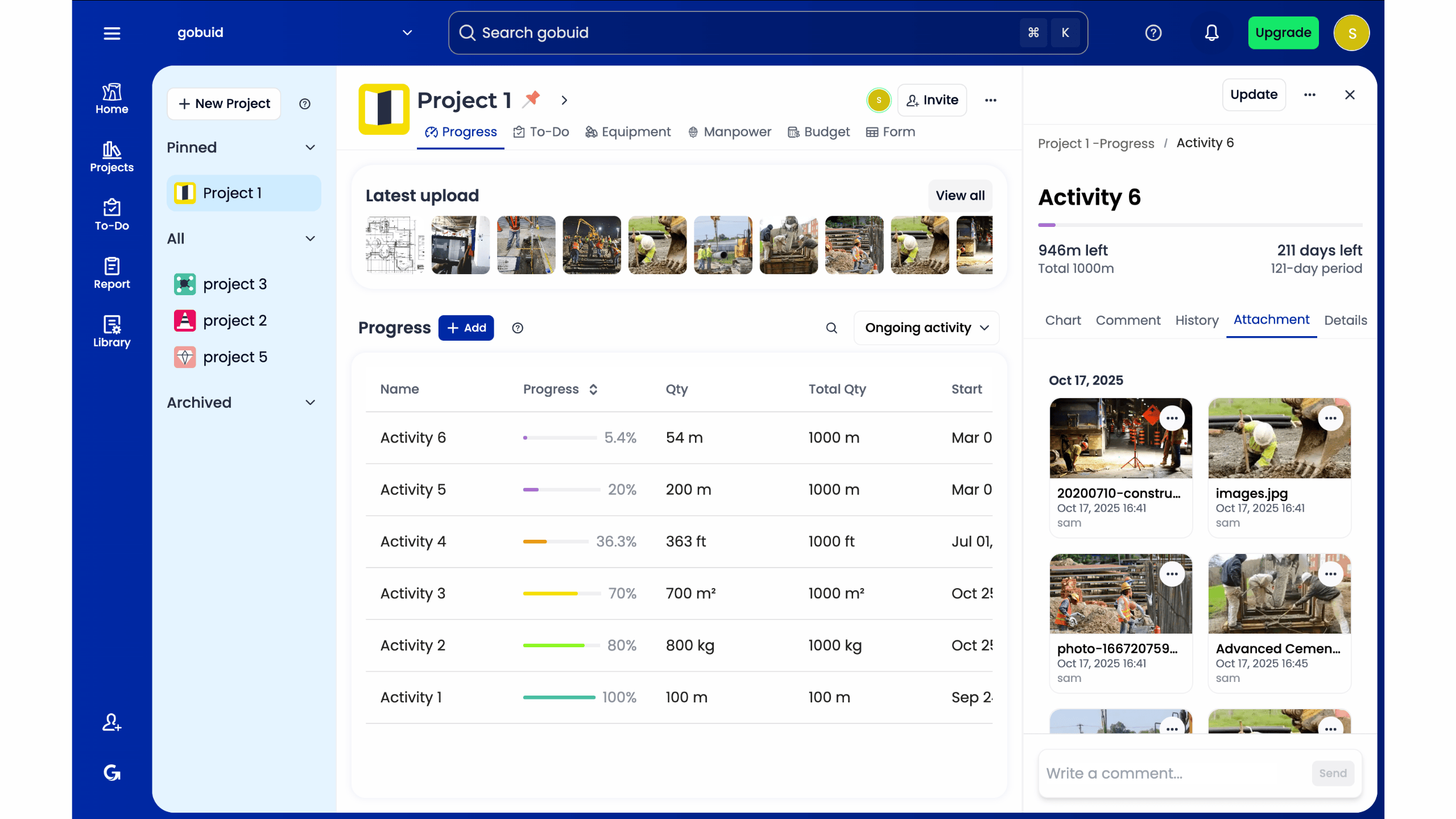
GoBuid acts as a digital foreman for your project. It was built by construction professionals who understand that site reality is messy and fast-paced. This isn't just another SaaS product; it's the connective tissue between the field and the office. It provides the visibility you need to maintain calm authority over demanding timelines. Every feature is designed to cut through the noise and deliver results without the emotional fluff of generic apps.
You can explore the full list of features to see how the platform handles submittals, budgets, and site diaries. Implementation is straightforward and carries no risk for your next project. It's time to stop chasing paper and start driving progress. Use GoBuid to bridge the gap and ensure your role as a construction project manager is defined by efficiency and professional precision.
Master the 2026 Job Site Today
The 2026 construction landscape demands more than just grit. Success as a construction project manager now hinges on your ability to bridge the gap between the job site and the digital office. You've seen how mastering automated compliance and real-time data flow can eliminate the 35% of time typically lost to manual admin tasks. By centralizing your toolkit, you move from reactive troubleshooting to proactive leadership.
It's time to reclaim your schedule and lead with a single source of truth. Stop chasing field updates and start driving results with a platform built for the modern digital foreman. You can generate professional reports in 1 click and maintain 100% visibility over manpower and equipment tracking. There are 0 lock-in contracts to worry about, giving you total flexibility to scale as your projects grow.
Streamline your project management with GoBuid; get started for free today.
The future of the industry is built on precision. You have the expertise; now grab the tools to match.
Frequently Asked Questions
What are the main duties of a construction project manager?
A construction project manager directs the project lifecycle from initial bidding to the final punch list. Primary duties include budget oversight, schedule management, and subcontractor coordination. You’ll spend 40% of your time on site and 60% managing digital workflows. Leading a project requires maintaining a single source of truth for all field reports and submittals to prevent costly rework.
Is a degree required to become a construction project manager in 2026?
A bachelor’s degree in construction science or engineering is required by 78% of tier-one contractors in 2026. While field experience remains vital, modern firms prioritize candidates with formal training in BIM and cost estimation. You can supplement your path with a Project Management Professional certification. This credential increases your marketability in a competitive, tech-driven industry.
How much do construction project managers earn on average?
The average salary for a construction project manager in 2026 is $108,500 per year. Entry-level roles start at $72,000, while senior directors in major metropolitan hubs earn upwards of $165,000. These figures reflect a 4.2% increase from 2025 data. Performance-based incentives often add another 10% to 15% to the base compensation for meeting strict safety and timeline milestones.
What is the best software for construction project management?
Buid is the most efficient software for modern managers who need to bridge the gap between the field and the office. It replaces fragmented spreadsheets with a centralized platform for real-time field reports and punch lists. The software reduces administrative overhead by 30% through automated data entry. It’s designed for the rugged site environment but offers the precision of high-end SaaS tools.
How does a digital site diary improve project outcomes?
Digital site diaries improve project outcomes by providing 100% transparency into daily site activities. They eliminate the 15% time waste associated with manual paper logging and physical filing. By capturing real-time photos and weather data, you create a permanent audit trail. This visibility allows you to resolve disputes in minutes rather than weeks, keeping the project moving toward completion.
What is the difference between a project manager and a construction manager?
A project manager oversees the entire business side of a build, including financing and high-level stakeholder communication. A construction manager focuses strictly on the technical execution and labor management on the job site. While the PM handles the strategic view, the CM ensures the site reality matches the plan. Both roles now rely on shared digital dashboards to stay aligned.
Can construction management software help with safety compliance?
Construction management software automates 85% of safety compliance tracking and documentation. It stores digital copies of worker inductions, safety permits, and equipment inspections in one accessible location. Automated alerts notify you 30 days before a certification expires, preventing costly site shutdowns. This proactive digital oversight has been shown to reduce recordable incident rates by 22% across mid-sized firms.
How do I transition from a site supervisor to a project manager?
Transitioning requires you to shift your focus from daily labor supervision to long-term financial and strategic planning. You’ll need to master cost-to-complete forecasting and contract negotiation. Start by taking on 20% more administrative responsibility, such as managing submittals or RFI logs. Completing a specialized certification in construction technology will prove you’re ready to handle the complex digital workflows required in 2026.